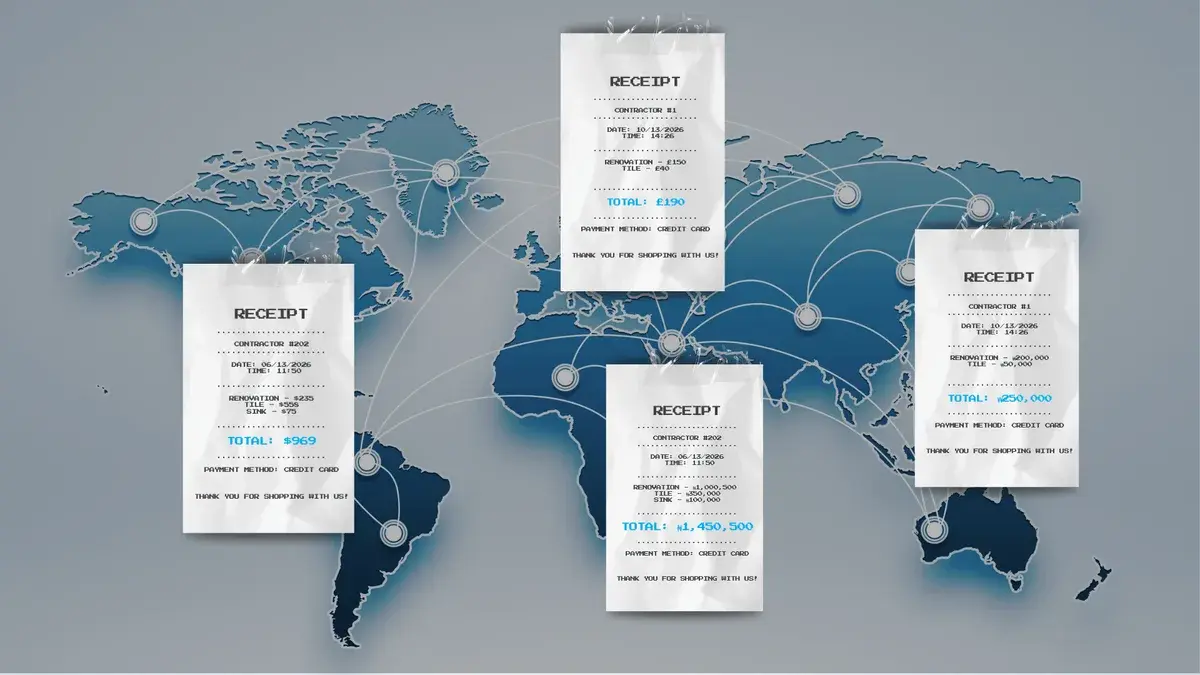
Choosing software for a multinational company is rarely simple. Finance teams need to account for different currencies, tax rules, approval policies, languages, legal entities, and accounting systems across the countries where they operate. Expense reporting software is no exception.
The stakes are high. According to the Global Business Travel Association, global business travel spending reached an estimated $1.57 trillion in 2025 and is projected to surpass $2 trillion by 2029. Travel and entertainment remains one of the largest controllable costs after payroll. For companies operating across multiple countries, the expense reporting layer sitting on top of that spend often determines whether month-end close runs smoothly or turns into a reconciliation exercise.
So what is the best expense reporting software for multinational companies?
The best platform is the one that handles multiple currencies, multiple legal entities, and multiple tax jurisdictions inside a single workflow. For most mid-market and enterprise finance teams operating across borders, that points to a card-agnostic, multi-currency platform that can handle multiple ERPs or accounting integrations like ExpensePoint.
Think about a finance team closing the month for a company with offices in Toronto, London, and Singapore. Employees submit expenses in US dollars, British pounds, euros, and local currencies. The UK entity needs VAT captured correctly. The US entity needs IRS-compliant meal documentation. Canada has its own GST, HST, PST, and QST requirements. When expense software is built for one country and one currency, every difference becomes a manual workaround.
That is why the better question is not which vendor claims to be the best. Most platforms can make that claim and point to reviews to support it. The more useful question is this: which expense reporting software is actually built for multinational reality, and what should you look for before buying it?
What to look for in expense reporting software for multinationals
The right platform for your company really depends on your structure, your accounting stack, and which countries you operate in. We have put together eight criteria that separate software built for global teams from software that only tolerates global complexity.
1. Native multi-currency support with live conversions
Look for software that shows live exchange rate conversion at the time of the transaction. Software that is not built to serve multinationals will most likely apply a blended rate at month-end, which then causes manual reconciliation.
ExpensePoint converts foreign expenses into the home currency using live rates on the transaction date, so a report that mixes US dollars, pounds, and euros stays accurate instead of shifting as exchange rates move. Approvers can also review spend in the submitted currency, and employees can work and be reimbursed in their preferred currency.
2. Bring your own card (BYOC)
For multinational companies, a card-agnostic setup is not optional. If you are a multinational company, you have most likely already built up credit lines and banking relationships across multiple countries. A closed-loop platform like Ramp that requires you to adopt its own card program may work for a US-centric company, but it is often a poor fit for a multinational business. It also does not have the ability to accommodate non-corporate card employees who still need expense reimbursements.
ExpensePoint supports bring your own card and bank feeds from around the world. That means your teams in London, Toronto, and Singapore can keep using the Visa, Mastercard, or Amex cards already issued by their local banks.
3. Multi-entity consolidation
Acquisitions, subsidiaries, and regional entities should not force finance teams into separate reporting environments.
If you operate across multiple entities, you need a platform that can consolidate spend across subsidiaries, departments, projects, and regions in one view. Without that, finance teams end up stitching together exports from each entity and recreating the global picture manually. Anything apart from this is inefficient.
ExpensePoint is built to support multi-entity structures so finance leaders can review consolidated spend while still allowing each entity to code to its own chart of accounts, cost centers, and internal requirements.
4. Global tax and compliance support
The best platform for multinationals must accommodate different documentation rules across jurisdictions. These requirements vary significantly by country, both in what counts as a valid record and how long records must be retained. For example:
- United States (IRS): Under the $75 rule, a receipt is required for any travel or entertainment expense of $75 or more, and records are generally kept for a minimum of three years.
- United Kingdom (HMRC): To reclaim VAT, you need a valid VAT invoice, not just a receipt. VAT records are kept for six years.
- Canada (CRA): Documentation is tiered by amount, and provincial sales taxes (GST, HST, PST, and QST) vary, but records must generally be kept for six years.
ExpensePoint captures the documentation each jurisdiction requires, provides full GST, HST, QST, and PST split-tax coding, and keeps records timestamped and audit-ready.
5. Flexible ERP and accounting integration
Global finance teams rarely run a single accounting system. Your platform should sync cleanly with NetSuite, QuickBooks, Sage Intacct, Xero, Microsoft Dynamics 365, or SAP Business One, and map to your existing chart of accounts without forcing a major reimplementation project.
ExpensePoint connects approved, coded expenses into your existing accounting and ERP environments through 150+ API or custom integrations.
6. Real human support beyond setup
Global rollouts are rarely one-time projects. New entities are added. Approval structures change. New users need training. Policies evolve. That is why support matters well beyond setup. Many software vendors now push customers toward chatbots, self-serve help centers, and ticket queues. For multinational organizations, that often is not enough.
Look for a platform that offers service-led onboarding, training, and access to real people who understand the product and your rollout structure. This is one of ExpensePoint's key differentiators. Support comes from real tax experts based in North America, not bots.
7. Ease of use that drives adoption across regions
A global rollout only works if employees in every country actually use the system. A clunky app means employees will delay submissions, hold onto paper receipts, or avoid the process entirely. That creates gaps in reporting regardless of how powerful the back end is.
ExpensePoint is consistently rated as one of the easiest expense platforms to use across mid-market and enterprise users on Capterra, which matters more when your workforce is distributed across multiple locations, business units, and time zones, and speaks multiple languages.
8. Security certifications and data residency
For a cross-border business, where data lives and which standards a vendor meets is a procurement requirement, not a nice-to-have. Look for recognized certifications like SOC (SSAE18), PCI-DSS, and GDPR compliance. Also check that the vendor has a dedicated security team, clear data-residency options, and enterprise access control through single sign-on (SSO/SAML).
ExpensePoint supports enterprise-grade security requirements, including GDPR compliance, PCI-DSS, SOC standards, and SSO through SAML 2.0, with hosting options in both Canada and the US.
How the leading expense platforms compare for global use
| Factor |
ExpensePoint |
Closed-loop platforms (e.g. Ramp, Brex) |
Legacy enterprise platforms (e.g. SAP Concur, Emburse) |
| Card model |
Card-agnostic with real-time transaction feeds |
Requires use of vendor-issued card |
Card-agnostic, but card-feed setup varies by region |
| Multi-currency |
Native, live rate at transaction date |
Built around US banking |
Supported, often with heavier configuration |
| Multi-entity consolidation |
Built in |
Limited for complex global structures |
Supported, typically at higher-tier plans |
| ERP integration |
150+ integrations for cloud and on-premises ERPs and software |
Strong with modern stacks, narrower for legacy ERPs |
Broad but implementation heavy |
| Implementation |
Service-led, multilingual onboarding |
Self-service, fast, but requires card switch |
Often long, with paid implementation |
| Support model |
Dedicated account manager |
Mostly self-serve and chat |
Largely ticket based |
| Best for |
Mid-market and enterprise multinationals keeping existing cards |
Start-ups and US-centric companies ready to adopt a new card program |
Large enterprises with dedicated admin resources |
Managing reimbursements and compliance across countries
The question that follows global expense reporting is almost always reimbursements: how do you pay people back fairly and on time when they spend in different currencies and live under different tax rules?
ExpensePoint supports out-of-pocket reimbursements with each user able to operate in their own currency. Because policy checks happen during submission, non-compliant claims can be flagged before they reach the approver.
Compliance scales in the same way the reporting does, through a few connected mechanics:
- Jurisdiction-aware documentation
- Full tax coding
- Configurable policy rules by entity
- Complete audit trail
Ready to consolidate your global expense reporting?
Book a discovery call with ExpensePoint.
BOOK DEMO
Frequently Asked Questions