Situation
If you’re not one of the largest issuers in your market, the risk you face today is materially different than it was even a few years ago. FinTech participation in commercial payments continues to accelerate, while larger issuers have invested heavily in their commercial and business card technology stacks through a combination of build, buy, and partnership strategies. At the same time, increased M&A activity among regional banks is creating larger, more concentrated competitors with greater scale and investment capacity.
In parallel, FinTechs and large issuers are rapidly advancing their use of data, AI, conversational interfaces, and agentic workflows. Modern issuer-processors are eroding the historical dominance of legacy providers, and the industry has even seen deeper structural integration between networks and issuing environments. The cumulative effect is a growing concentration of commercial payments volume among a smaller number of players, combined with above-average growth from FinTech-native entrants.
This risk extends far beyond card portfolio attrition. Commercial card and business card programs are among the most “sticky” and profitable relationships banks maintain. Losing them exposes issuers to broader erosion across business banking, treasury management, and operating account relationships. As a result, regional banks, community banks, and credit unions increasingly find themselves in the competitive crosshairs of both scaled issuers and FinTechs offering overlapping products and services.
Inflection Point
Smaller issuers retain important advantages. Strong client relationships, superior service models, and organizational agility remain real differentiators. However, scale remains scale. Limited resources and constrained budgets make it more difficult—though not impossible—to build, launch, and continuously evolve modern commercial payments offerings.
Historically, reliance on legacy partners and agent banking relationships was sufficient, particularly when paired with relationship management and competitive rewards. That model is no longer enough. Commercial payments platforms —defined by usability, functionality, intelligence, and integration—have become central to the value proposition. Larger issuers and FinTechs now offer credit access and rewards while layering on superior digital experiences and data-driven capabilities.
Given this environment, smaller issuers face a clear strategic choice: remain Innovators or risk becoming Laggards in the commercial payments landscape.
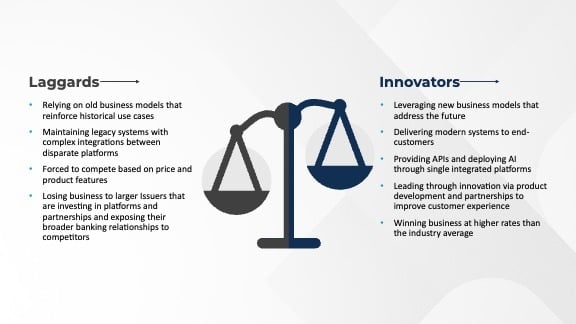
The distinction between Innovators and Laggards is increasingly defined by platform ownership, control over customer experience, and economic leverage.
We are already seeing larger issuers and FinTechs outperform smaller institutions by leveraging modern platforms, data-driven underwriting, and lower operating costs to deliver faster, more personalized digital experiences. Failure to address these challenges head-on can result in:
-
Portfolio compression and declining card relevance
-
Loss of primary operating account and lead banking status
-
Revenue erosion across interchange, treasury management, and small business services
-
Increased consolidation pressure and, in some cases, institutional exit
Importantly, innovation is not out of reach for smaller issuers. Many are bringing elements of their card programs back in-house and partnering strategically with FinTechs to accelerate modernization while preserving control. These issuers are increasingly prioritizing:
-
Ownership and influence over the end-customer experience
-
Meaningful influence over product roadmaps and pace of innovation
-
The ability to defend and grow economics rather than outsourcing them
Ultimately, long-term success will be driven by an issuer’s ability to retain ownership of client relationships, capture the majority of portfolio economics, and deliver compelling customer experiences. This raises a critical question: what defines a successful FinTech partnership?
Fintech Partnerships
Smaller banks and credit unions require partners that understand both the regulatory environment and the operational realities of working with financial institutions. While many variables influence partner selection, several consistently matter most:
-
Risk Mitigation:
Platforms must be banker-grade, secure, and compliant, with certifications and controls required to operate within regulated environments.
-
Speed to Market:
Solutions must be deployable quickly, allowing issuers to respond to competitive threats and continuously enhance customer experience, retention, and acquisition.
- Issuer Brand and Customer Experience:
White-labeled, digital-first expense management platforms should align seamlessly with the issuer’s brand while delivering intuitive, highly functional user experiences.
- Economics:
Issuers must regain economic control by bringing issuance closer to home and partnering on SaaS models that align pricing with usage, outcomes, and success.
How ExpensePoint Can Help
ExpensePoint brings two decades of experience delivering expense management solutions for banks, credit unions, and commercial card issuers. Our banker-grade, white-labeled, API-driven, and AI-powered platform integrates enhanced commercial card data into existing issuer technology stacks, digital banking portals, and third-party systems.
We have extensive experience supporting issuers and end-customers across North America and international markets, working directly with financial institutions as well as alongside networks and issuer-processors. This experience enables us to reduce execution risk, accelerate time to market, and preserve issuer brand and economics throughout implementation and growth.
What differentiates ExpensePoint is not just technology, but alignment. Our vision and roadmap are built to support smaller issuers seeking to compete effectively against larger institutions and FinTech-native challengers—without relinquishing control of their customer relationships.
Our modular platform supports multiple use cases across customer segments and sectors, while our flexible engagement model allows partners to determine how best to leverage our sales support, implementation, onboarding, and program management services.
If this perspective resonates, we welcome a conversation with issuers evaluating the next phase of their commercial card program and payments strategy.