Finance teams have gotten used to a strange tradeoff. If you want card transactions to show up in your expense management software right away, the fastest path has often been to adopt the card that comes with the software. Keep the card program your business already chose, and you may be left waiting for a bank feed or login-based connection to catch up.
We don't think real-time visibility should require a new card program.
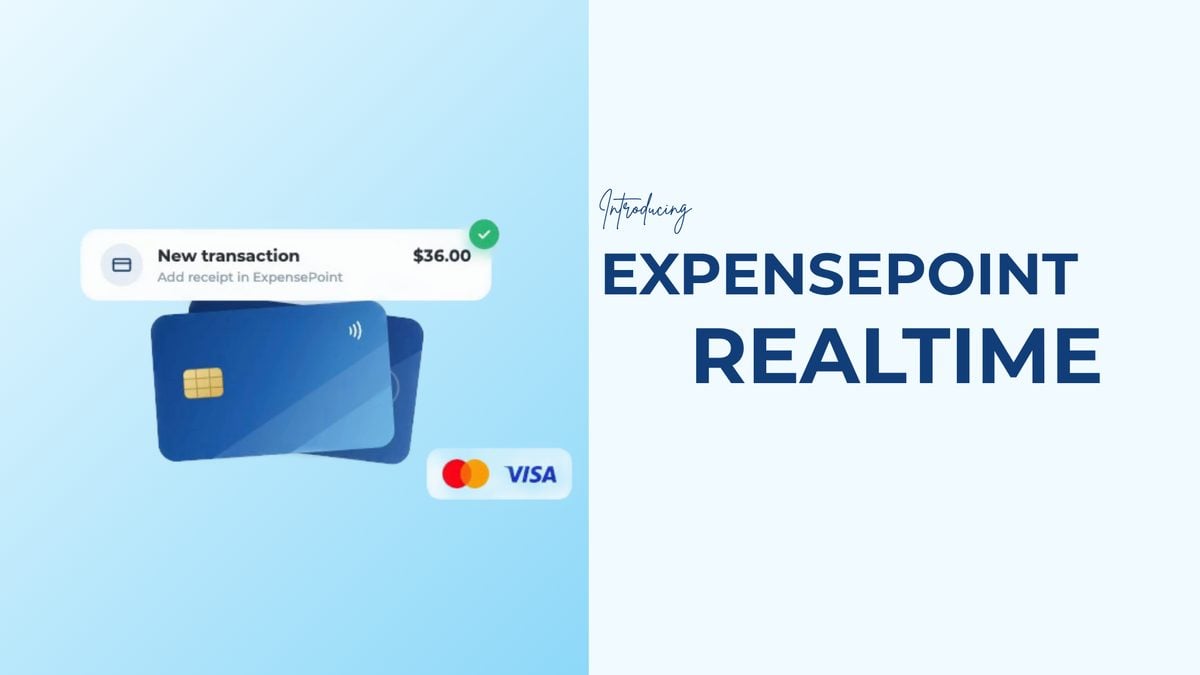
Today, we're introducing ExpensePoint Realtime, a new way to bring spend activity into ExpensePoint the second that it happens. Employees are then reminded to add their receipt while the purchase is still fresh, and accounting teams get an immediate view of company spend and budgets.
That changes more than how quickly a transaction appears on a screen. A receipt can be captured before it gets lost or crumpled at the bottom of a bag. An unexpected purchase can become visible while it is still recent enough to investigate. Expense reports can start taking shape throughout the month instead of being rebuilt from memory at month-end. And finance can spend less time chasing documentation because the expense process starts when the purchase happens, not days later when the transaction finally reaches the system.
The 48-hour lag
Bank feeds don't deliver transaction data to expense or accounting software as a purchase happens. They deliver it 24 to 48 hours later, once the transaction has posted and the bank has aggregated it into its own systems.
That lag is exactly where reconciliation breaks down. By the time a transaction finally shows up, the receipt is cold, the employee has moved on, and finance is left matching a bare line item to a purchase nobody remembers clearly. Close the lag, and reconciliation stops being a forensic exercise and starts being a same-day match.
Meet ExpensePoint Realtime
Your cards. Your rewards. Real-time expense automation.
The real value of seeing a transaction sooner is not the timestamp. It is what employees and finance can do because the data arrives sooner.
See spend while it is happening
Transactions appear in ExpensePoint immediately after authorization, usually within seconds. Finance gets visibility into current card activity instead of waiting for a transaction to post, or a statement or bank feed to catch up, giving teams a more current view of spend throughout the month and allowing you to budget and forecast appropriately.
Ask for the receipt while it is still in hand
The moment an employee taps their card, they get a notification asking for the receipt right then, while it's still in their hand and the purchase is still top of mind. That single change in timing is doing real work: employees are 25% more likely to submit a receipt immediately when the request arrives in the moment, compared to a later reminder.
Start expense reports automatically
Instead of an employee starting from a blank report and rebuilding a month of activity from memory, ExpensePoint automatically turns card transactions into expense reports. The employee's job shrinks to attaching documentation and hitting submit. Reports can also be generated around the card's billing cycle so the workflow lines up more naturally with reconciliation.
Transactions and receipts match themselves
Credit card reconciliation has always meant manually pairing a card statement line against a pile of receipts after the fact. With structured transaction data arriving at the moment of purchase, ExpensePoint automatically matches the receipt an employee attaches to its transaction, instead of finance cross-referencing dates, amounts, and merchant names by hand at month-end.
Give finance an earlier signal
Company administrators can see eligible transaction activity as it arrives and use configurable minimum-amount thresholds for notifications. A large or unexpected purchase does not have to wait for month-end to become visible. You're also able to follow a transaction from Pending to Post, so you can see where a transaction sits in the card lifecycle.
Your card program stays exactly as it is
ExpensePoint Realtime replaces the login-dependent connection most expense management software or feed connectors have, not the card program. Existing cards, credit lines, and rewards through Visa, Mastercard, Amex, Chase Ink, Capital One, Citi, Bank of America, and Wells Fargo carry over unchanged. Nobody has to give up points to get faster visibility.
ExpensePoint policy checks every transaction automatically
Faster visibility only pays off if it comes with faster policy enforcement. Alongside Realtime, ExpensePoint now runs report-level spend controls that flag issues before a report ever reaches accounting:
- Category daily limits cap how much your team can spend in a given category per day.
- Category conflicts flag expense combinations that shouldn't appear on the same report.
- Expense and transaction limits catch individual charges that cross policy thresholds.
Together with a real-time feed, that means a policy issue surfaces at the moment of spend, while there's still time to act on it, instead of during a review three weeks later.
The purchase happens. ExpensePoint Realtime catches it. Reconciliation stops being a scramble.
That's the whole model. Employees don't have to remember to log a purchase. Finance doesn't have to wait 24 to 48 hours for a bank feed to catch up, then hand-match it to a receipt. The transaction, the receipt, and the match all land together, continuously, all month, so reconciliation is a running total instead of a month-end sprint.
Ready to see spend as it happens instead of at month-end? Enable ExpensePoint Realtime to connect your existing cards and start capturing receipts before they're lost.
Frequently Asked Questions